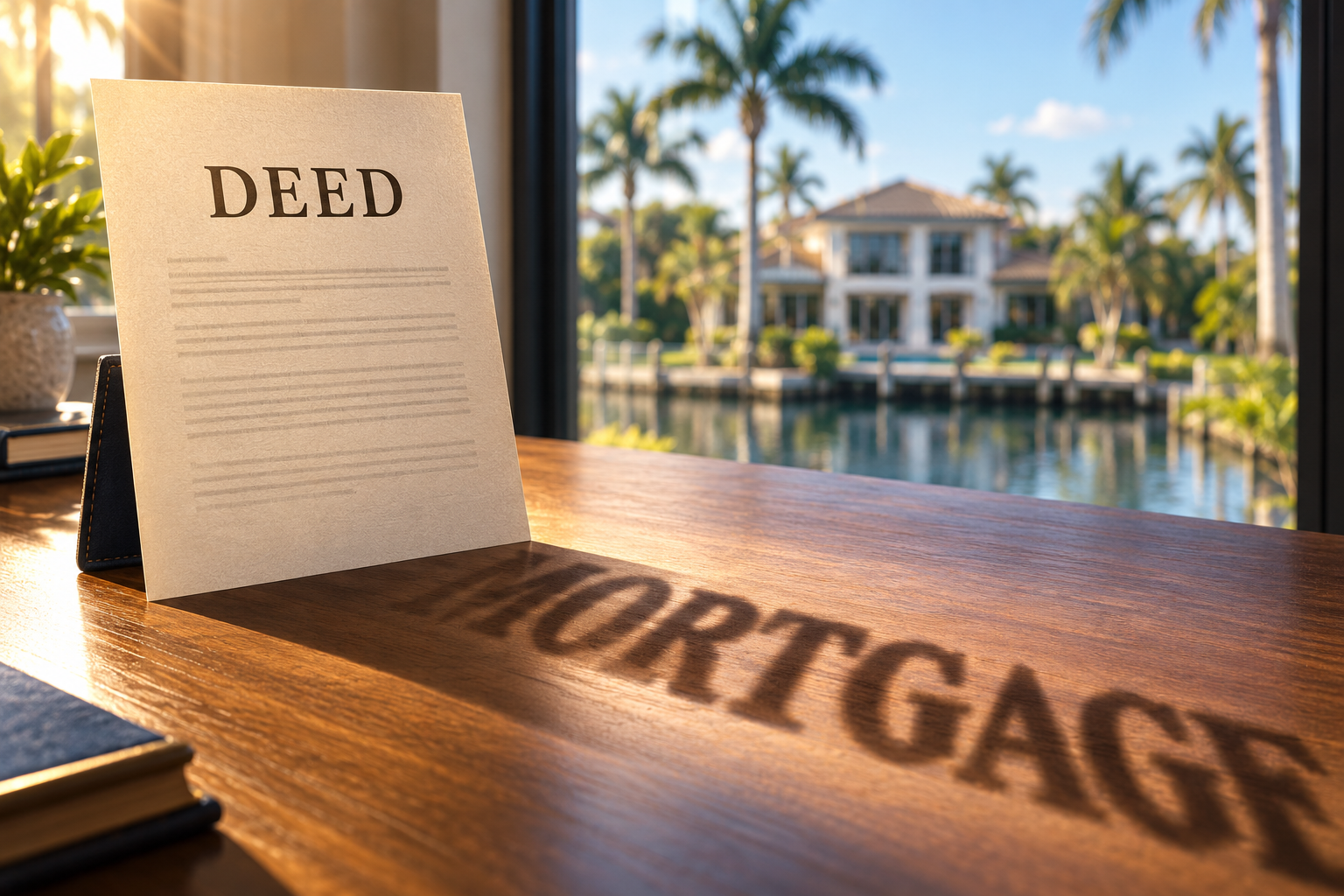
A Florida property owner signs a deed to obtain money, with an understanding that the property will be returned when the money is repaid. Or a buyer purchases property through monthly installments while the seller keeps the deed until the final payment. What happens when a payment is missed?
The answer depends on the transaction’s purpose. When a deed or other written instrument serves as security for payment, Florida law treats it as a mortgage. Enforcing that security requires the protections of judicial foreclosure. The document’s title does not decide the parties’ rights.
The statutory rule: security creates a mortgage
Three Florida statutes work together:
- Section 697.01(1) treats written conveyances and sales instruments intended to secure payment as mortgages, subject to the same foreclosure rules and protections.
- Section 697.02 makes a mortgage a specific lien, a legal claim against the property securing payment. It does not convey legal title or the right to possession.
- Section 702.01 requires mortgages to be foreclosed in equity, through a court proceeding. [1]
Together, these provisions prevent a creditor from using a deed-shaped security agreement to obtain ownership merely because the debtor defaults. If the instrument is a mortgage, it must be enforced as one.
A deed given as security does not make the lender the owner
In Thomas v. Thomas, a financially distressed owner deeded property to his brother and simultaneously agreed to purchase it back over twenty years. He remained in possession and responsible for repairs, insurance, and taxes. The Florida Supreme Court held that the arrangement was a mortgage rather than a conditional sale. The transaction allowed the owner to obtain financing against his property, and the absence of a separate promissory note did not change that conclusion. 96 So. 2d 771, 772–74 (Fla. 1957). [2]
The practical consequence follows from section 697.02: a deed determined to be mortgage security operates as a lien, rather than a transfer of legal title or possession. That does not erase the debt. It means the creditor’s rights are those of a mortgage holder.
For example, suppose an owner receives $60,000 and signs a deed under an agreement requiring repayment with interest. The deed is supposed to protect the person advancing the money. If the evidence establishes a secured loan, recording that deed does not entitle the lender to take the property automatically after a missed payment.
Contracts for deed can require foreclosure, too
In Mid-State Investment Corp. v. O’Steen, purchasers borrowed money, assigned their deed to the lender, and received a contract for deed providing for monthly payments. The contract purported to allow forfeiture and repossession after default. The court held that the arrangement was a mortgage and that the lender had no legal right to repossess or trespass on the property. 133 So. 2d 455, 455–58 (Fla. 1st DCA 1961). [3]
H & L Land Co. v. Warner applied the principle to a direct installment sale. Where the seller had received part of the price and the buyer had possession and the benefits and burdens of ownership under a contract the buyer could enforce by requiring the seller to convey the property, the seller could not simply cancel the buyer’s equitable ownership. 258 So. 2d 293, 295–96 (Fla. 2d DCA 1972). [4]
There is an important title distinction. In this type of installment transaction, the seller may retain bare legal title as security while the buyer holds equitable ownership, an ownership interest recognized even before the deed is delivered. That is different from an existing owner giving a lender a deed solely as collateral. Both arrangements can require mortgage remedies, but their title histories differ.
Consider a buyer who pays a down payment, moves in, pays taxes, and makes monthly purchase payments for years. A provision allowing the seller to cancel the contract, retain all payments, and take the property back does not necessarily make that remedy enforceable. If the arrangement falls within Warner, the seller must respect the buyer’s mortgage-related protections.
Courts examine the whole transaction
The central question is whether the parties intended the property to secure an obligation. Courts examine the documents together with the circumstances and the parties’ conduct. Relevant evidence may include:
- Whether the transaction began as a request for a loan
- Whether a repayment obligation continued after the deed
- The amount advanced compared with the property’s value
- Who remained in possession and paid taxes, insurance, and repairs
- Agreements to reconvey, payment records, and communications describing the arrangement
In Bernstein v. New Beginnings Trustee, LLC, the Fourth District reversed orders arising from an eviction because factual issues remained over whether an apparent sale, leaseback, and repurchase option was actually a mortgage. The court required an evidentiary hearing; it did not finally declare the transaction a mortgage. 988 So. 2d 90, 94–96 (Fla. 4th DCA 2008). [5]
The person seeking mortgage treatment must prove the necessary facts. A private, unexpressed intention does not alone rewrite a transaction. Valk v. J.E.M. Distributors of Tampa Bay, Inc., 700 So. 2d 416, 419 (Fla. 2d DCA 1997), explains the fact-sensitive inquiry and the claimant’s trial burden. [6]
Genuine sales and foreclosure settlements require separate analysis
Not every purchase agreement is a mortgage. Warner expressly distinguished ordinary short-term contracts leading to closing, purchase options, and contracts lacking the specified ownership and enforceability features. 258 So. 2d at 296. [4]
Likewise, an actual conveyance that settles and cancels a mortgage debt can transfer ownership. The Florida Supreme Court recognized that distinction in Holmberg v. Hardee, 90 Fla. 787, 808–13, 108 So. 211 (1925). An optional right to repurchase did not turn the completed debt settlement into continuing mortgage security. [7]
A genuine deed-in-lieu or negotiated foreclosure settlement therefore needs its own analysis. In Rothschild Reserve International, Inc. v. Silver, the court upheld a deed arrangement resolving an already-pending foreclosure after judgment, based on the settlement and factual findings. 830 So. 2d 224, 225–26 (Fla. 4th DCA 2002). That holding should not be read as permission to use a deed taken at loan origination to bypass foreclosure. [8]
Start with the documents and the requested remedy
For an owner or installment buyer, preserve the complete agreements, payment history, communications, and recorded instruments. For a lender or seller, determine the proper remedy before attempting cancellation, eviction, or possession.
Later transfers also matter. Section 697.01(2) protects qualifying purchasers and mortgagees for value without notice who take under the grantee. The result between the original parties does not automatically resolve every later title claim. [1]
The useful first question is simple: was this an actual transfer of ownership, or was the property securing payment? Answering it correctly can determine whether the dispute belongs in a foreclosure proceeding.
General information only. The governing documents, facts, current law, defenses, deadlines, and procedural posture require attorney review. Begin any case inquiry with a non-confidential conflicts and availability review before providing documents or confidential facts.
Primary authorities
- Florida Statutes § 697.01, § 697.02, § 702.01.
- Thomas v. Thomas, 96 So. 2d 771, 772–74 (Fla. 1957).
- Mid-State Investment Corp. v. O’Steen, 133 So. 2d 455, 455–58 (Fla. 1st DCA 1961).
- H & L Land Co. v. Warner, 258 So. 2d 293, 295–96 (Fla. 2d DCA 1972).
- Bernstein v. New Beginnings Trustee, LLC, 988 So. 2d 90, 94–96 (Fla. 4th DCA 2008).
- Valk v. J.E.M. Distributors of Tampa Bay, Inc., 700 So. 2d 416, 419 (Fla. 2d DCA 1997).
- Holmberg v. Hardee, 90 Fla. 787, 808–13, 108 So. 211 (1925).
- Rothschild Reserve International, Inc. v. Silver, 830 So. 2d 224, 225–26 (Fla. 4th DCA 2002).